
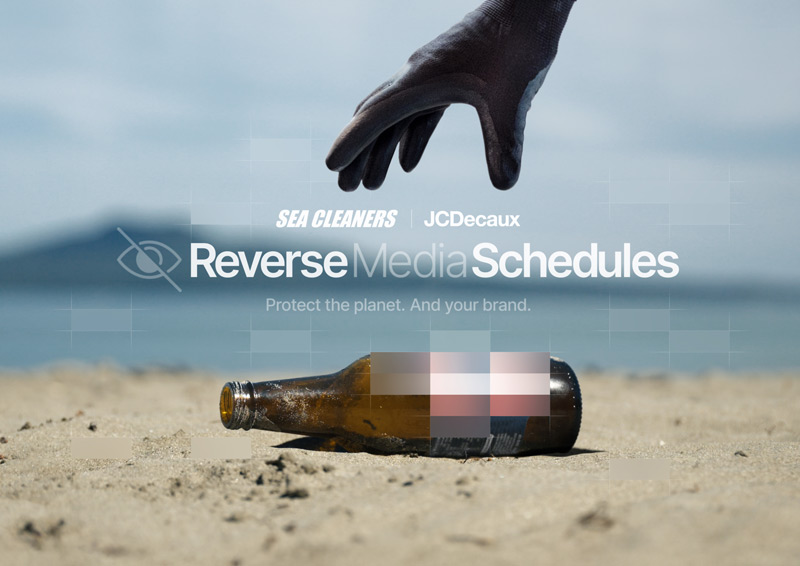
AUCKLAND, Today: Household name brands are running the worst outdoor ads in the world. They didn’t brief them, nor approve them, but they’re out there damaging their brand every day.
A study published in the Journal of Business Research*, and validated for the local market by Nielsen, shows that when a brand appears as litter, people are willing to pay less for its products. 2% less.
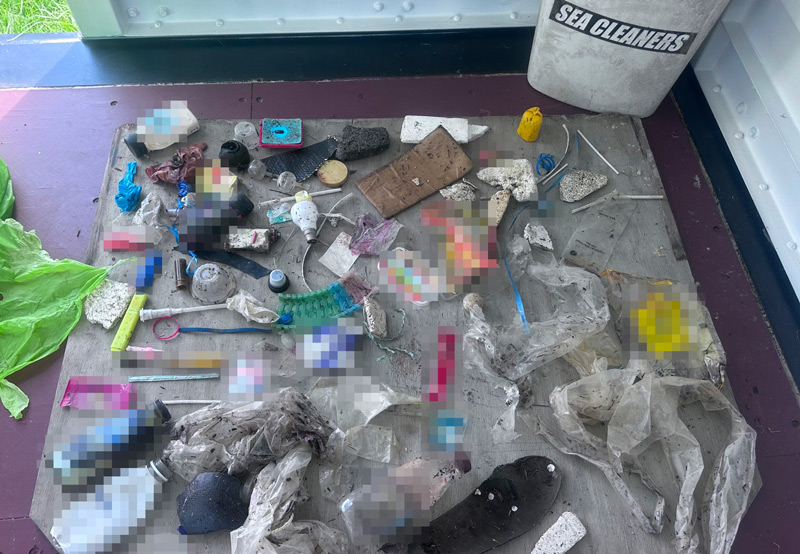
So every time a brand shows up as litter, they are running the most damaging outdoor ads imaginable.
That’s why Sea Cleaners and JCDecaux, the global leader in outdoor media, have teamed up to combat litter and take those ads out of rotation.
Every discarded bottle, can or wrapper becomes an unintended brand impression. And unlike traditional outdoor media, these impressions can actively damage perception rather than build it.
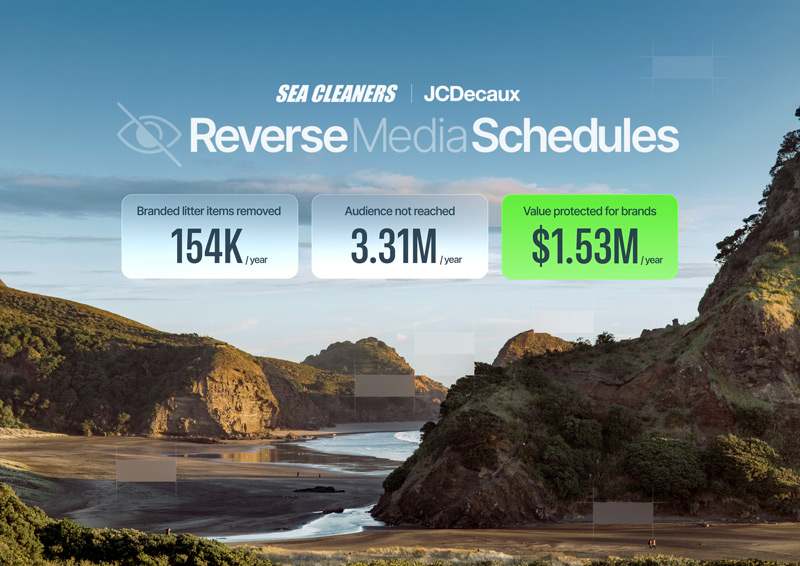
Today, Sea Cleaners and JCDecaux have launched Reverse Media Schedules, a new media product designed to help brands understand and respond to these negative impressions. It treats litter as a form of unplanned media and measures the value of removing it.
Developed by Dentsu Creative and Dentsu Media Aotearoa, along with advisory partners Finch and audience data experts Nielsen – they have combined litter audits, audience data and media modelling to calculate where branded waste is appearing, how visible it is and the potential impact on consumer perception and purchasing behaviour.
“The hardest part of the job isn’t picking up the litter, it’s the constant hustle required to raise funds and keep our boats in the water.” – Hayden Smith, founding trustee of Sea Cleaners
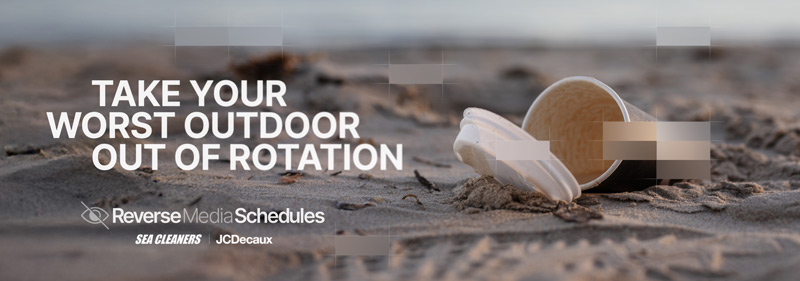
Research conducted by Nielsen surveying 1,000 people across 124 coastal destinations reinforces the impact. It found that 17.2% of people could recall specific brands they had seen as litter, days after visiting coastal areas, while 75% said they would view a brand more favourably if it supported clean-up efforts.
Already gaining momentum, brands in New Zealand including Heineken, Export and Monteith’s have invested in Reverse Media Schedules, committing a valuable financial contribution to help expand ocean clean-up efforts.
The initiative introduces a new way for brands to think about sustainability. Rather than treating clean-up as a charitable activity, it reframes it as a media investment that can help protect brand value while delivering measurable environmental impact.
The system also identifies hotspot locations, benchmarks brands against others in their category and estimates the value created by ongoing clean-up work. Businesses gain access to dashboards and reporting tools that track these insights and show the impact of supporting litter removal.
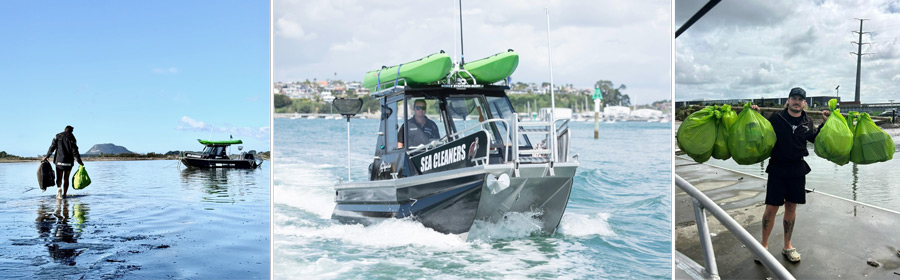
Over the past 23 years, Sea Cleaners has removed more than 21 million litres of rubbish from New Zealand’s beaches and waterways, growing from a single volunteer in a kayak into a full-time operation with a fleet of ten boats.
Reverse Media Schedules is designed to help scale those efforts by connecting environmental action with a model businesses already understand.
“Removing the worst outdoor ads allows us to deliver on our sustainability commitments, but also our commitment to iconic, impactful out of home advertising and making sure our clients are only seen in the right way, in the right places.” – Kurt Malcolm, Head of Trading Platforms at JCDecaux
Hayden Smith, founding trustee of Sea Cleaners, said: “The hardest part of the job isn’t picking up the litter, it’s the constant hustle required to raise funds and keep our boats in the water. This tool gives us a reason to talk to dozens of companies and a concrete business value that we are delivering for them.”
Kurt Malcolm, Head of Trading Platforms at JCDecaux said: “Removing the worst outdoor ads allows us to deliver on our sustainability commitments, but also our commitment to iconic, impactful out of home advertising and making sure our clients are only seen in the right way, in the right places.”
Brett Colliver, CCO of dentsu New Zealand, said: “Good for the planet and for business. It’s unfortunate that those two things don’t intersect more often, but that’s why we feel that Sea Cleaners and JCDecaux have unlocked something powerful in ‘Reverse Media Schedules’. And what’s really exciting is that it’s a model that can be scaled around the world.”
John Mescall, Global Chief Creative Partner Dentsu Creative, said: “The responsibility for litter lies not just with the public and companies creating packaging. It also lies with us, the advertisers who help those products become so popular. With media, creative and data being so intimately linked within our business, dentsu is uniquely positioned to create an innovation like this and it’s a fantastic demonstration of a key dentsu philosophy, Sanpo Yoshi – good for people, good for business, good for society.”
“Good for the planet and for business. It’s unfortunate that those two things don’t intersect more often, but that’s why we feel that Sea Cleaners and JCDecaux have unlocked something powerful in ‘Reverse Media Schedules.” – Brett Colliver, CCO of dentsu New Zealand
The cost of littered media
- Sea Cleaners has operated for 23 years, removing more than 21 million litres of rubbish from New Zealand waterways and coastlines
- Reverse Media Schedules combines litter audits, audience data and media modelling to estimate the business impact of litter visibility
- *Research from the University of Manchester found consumers are willing to spend 2% less on a product they have seen as litter. Source: Roper, S and Parker, C (2013) Doing well by doing good: a quantitative investigation of the litter effect. Journal of Business Research, 66 (11). pp. 2262-2268. ISSN 0148-2963
- Nielsen’s branded litter study surveyed 1,026 people across 124 coastal destinations.
- 75% of respondents said they would view a brand more favourably if it partnered with Sea Cleaners.
- 17.2% of people could recall brands (unprompted) that they had seen as litter 7 days after visiting coastal areas.
- The initiative was developed with Sea Cleaners, Dentsu Creative, JCDecaux and Nielsen
- The ambition is for Reverse Media Schedules to expand internationally
CREDITS
Clients: Sea Cleaners, JC Decaux, DB Breweries Limited
Creative Agency: Dentsu Creative Aotearoa (New Zealand)
Media Agency: Dentsu Media Aotearoa (New Zealand)
Production Company: The Post Office
Strategic Advisors: Finch
Research & Audience Measurement: Nielsen
About Dentsu
Dentsu is an integrated growth and transformation partner to the world’s leading organizations. Operating across 120 countries it delivers end-to-end experience transformation by integrating its services across Media, CXM and Creative, while its business transformation mindset pushes the boundaries of transformation and sustainable growth for brands, people and society.
- Find out more: www.dentsu.com / www.group.dentsu.com
Dentsu, Innovating to Impact.
- Find out more: www.dentsu.com / www.group.dentsu.com
About Sea Cleaners
Through sponsorship, Sea Cleaners educate and coordinate volunteers to remove debris from our marine and coastal environment. They are committed to preserving New Zealand’s stunning coastline for the benefit of marine life and for the enjoyment of all.
About JCDecaux
JCDecaux is the global leader in out-of-home advertising, delivering innovative and sustainable media solutions across street furniture, transport and billboard environments. Operating in more than 80 countries, the company partners with cities and transport networks to create high-quality public infrastructure funded by advertising, enabling brands to connect with audiences at scale in premium, high-traffic locations.
Share this Post